

Exclusive JNews Lebanon
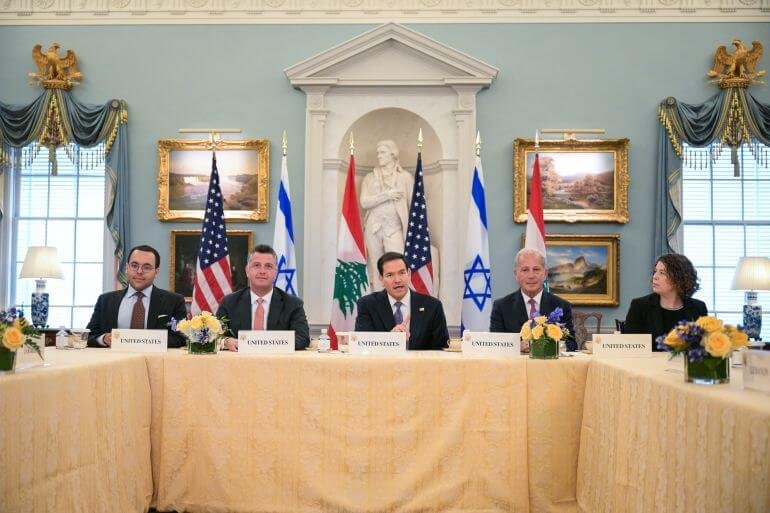
The region has entered an unprecedented political and military gray zone, with the Lebanese scene hanging between a fire consuming the South and negotiations in Washington consuming time in anticipation of the parallel “Islamabad” talks. In a historic development that has held everyone’s breath over the past hours, the fourth round of direct Lebanese-Israeli negotiations at the US State Department—backed by immense US-Saudi pressure—has yielded a diplomatic breakthrough. This resulted in the drafting of a joint statement and a security action plan distributed to presidential headquarters in Lebanon for discussion.
Behind the Scenes: The “Dahiyeh for the North” Equation
The repercussions of the secret, stormy contact between US President Donald Trump and Israeli Prime Minister Benjamin Netanyahu dominate the atmosphere. According to JNews Lebanon’s sources in the US capital, Trump expressed deep concern over Netanyahu’s ongoing conflict with Lebanon, firmly confronting him regarding the expansion of attacks.
This American pressure produced a tactical “Trump truce,” establishing a temporary equation: sparing the Southern Suburbs of Beirut (Dahiyeh) from violent raids in exchange for Hezbollah refraining from shelling northern Israeli settlements. Although this truce is nearing a collapse on the ground due to Israeli raids reaching Khaldeh on the outskirts of the capital, and the party’s shelling on the borders of the North in response to violations, the field performance has proven a tacit commitment to this equation to protect the capital. In contrast, Netanyahu emerged with a veiled threat, stating, “Many of those targeting Israel are in Beirut,” while simultaneously announcing that he shares Trump’s goal of disarming Hezbollah ahead of a future peace between the two countries.
JNews Information: The “Pilot Zones” Blueprint
JNews Lebanon has learned from diplomatic sources monitoring the negotiations that the presidential envoy, Simon Karam, and the Lebanese delegation engaged in complex discussions with the participation of Daniel Holler, representing US Secretary of State Marco Rubio. According to the joint statement, the two sides, under US auspices, agreed on a security framework based on recent discussions, which includes the following pivotal points:
- Gradual Ceasefire and “Pilot Zones”: Accelerating the establishment of pilot zones where military operations cease, followed by a gradual Israeli withdrawal, allowing the Lebanese Armed Forces (LAF) to assume exclusive control over the territory and exclude any non-state armed group.
- The Litani Condition and Disarmament: A prerequisite for the ceasefire to enter into force is the complete cessation of fire by Hezbollah and the evacuation of all its elements from the area south of the Litani River, alongside dismantling armed groups and preventing their reconstitution.
- Exclusivity of Weapons and Sovereignty: The statement affirmed that the future of the relationship is to be decided exclusively by the two sovereign governments, with an absolute rejection of any non-state actor holding Lebanon’s future hostage. The statement also condemned regional destabilization activities, in an implicit nod to the recent strikes impacting Kuwait Airport despite the ceasefire between Tehran and Washington.
The Volcanic Field and Baabda’s Pressures
On the ground, the Baabda Palace turned into an operations room where the President of the Republic and the Army Commander followed the course of negotiations moment by moment. Sources from the palace told JNews Lebanon that the primary obstacle still lies in “simultaneous parallelism”—the immediate freezing of hostilities alongside a full Israeli withdrawal. The Israeli side proposed behind closed doors that the Lebanese Army deploy in certain areas without the withdrawal of the occupation forces, a proposal the Lebanese delegation automatically rejected, holding firm to full sovereignty.
Lebanon is currently negotiating its final breath; either the “Pilot Zones” blueprint and the Arab-American backing succeed in restraining the Israeli military machine ahead of the sessions scheduled for June 22, or the fragile truce will collapse, plunging the region into a redrawing of maps through iron and fire.
