





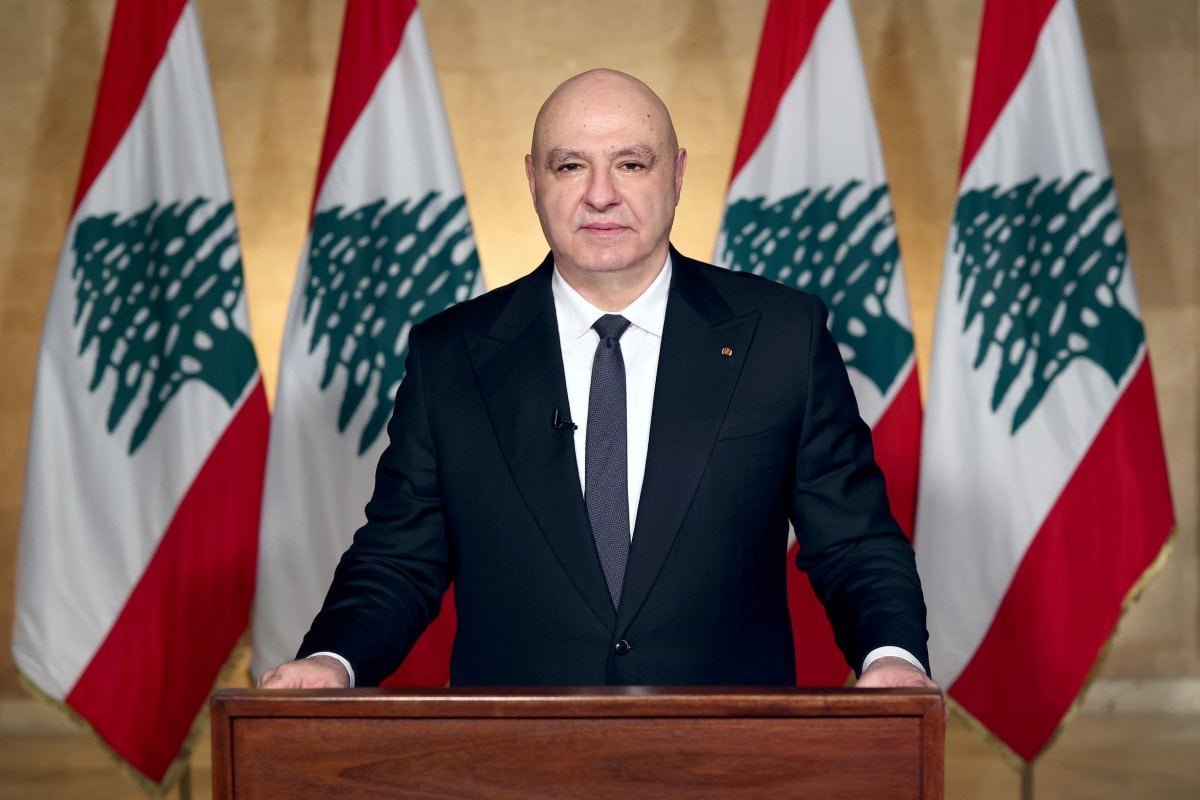
Arab News has published a comprehensive new report detailing the possibility of a historic meeting between Lebanese President General Joseph Aoun and Israeli Prime Minister Benjamin Netanyahu at the Oval Office, hosted by US President Donald Trump in Washington.
The report, translated by Lebanon 24, states that “while Lebanese-Israeli talks appear to be progressing smoothly, the fate of the invitation extended to the Lebanese president to meet Israeli Prime Minister Benjamin Netanyahu in the Oval Office remains unclear.” It added: “If this invitation stands, the meeting will be of paramount importance—a true test of leadership broadcast live before the entire world.”
The report pointed out that for President Aoun, the stakes and risks surrounding this meeting are immense: “The actions of both Trump and Netanyahu are unpredictable, and nothing can fully prepare Aoun for what they might say. The US President is fully aware of the domestic impact this has on Aoun’s local audience and the wider Arab world, particularly the Gulf states. The meeting will be akin to walking through a minefield, but the worst possible outcome would be missing it entirely, losing global support, and returning to isolation—a chance that may never come again.”
The analysis added: “Aoun has a strong message to deliver on behalf of Lebanon, and he is the right person to carry it, given his deep roots in southern Lebanon. Furthermore, the town of Bint Jbeil, which has been devastated by Israel, has a large diaspora community in the state of Michigan—a critical voting base targeted by Trump.”
State Sovereignty vs. Hezbollah’s Military Grip
The report noted that “Lebanon is not weak; its society is resilient, and its model of coexistence among various sects serves as an example for the region.” It continued: “The state is structurally weak when facing Hezbollah militarily, but Gaza has proven that there is no purely military solution. Conversely, the Lebanese state is powerful when it guarantees sovereignty and security for its citizens, especially in the South, where people need the protection of the state and the implementation of the Taif Agreement.”
The report went on to state: “We are paying the price for past mistakes, one of which was the failure to finalize the May 17, 1983 agreement between Israel and Lebanon. All three parties involved—Lebanon, Israel, and the United States—bear responsibility for that failure, and the victims were the people of southern Lebanon. Another mistake occurred in 2000 when Israel withdrew from southern Lebanon; it negotiated the withdrawal with Hezbollah and handed that part of the country over to them instead of the Lebanese state.”
Reviving the May 17 Framework as a Starting Point
According to Arab News, Aoun can confront these challenges with a tangible strategy by re-introducing the core framework of the May 17 agreement as a diplomatic starting point.
“Obviously, we are no longer in 1983, but the core messages of that agreement remain valid today. The main message is the absolute necessity of replacing the 1949 Armistice Agreement, which Israel violated after the 1967 war. Furthermore, the May 17 agreement was not a normalization peace treaty involving the exchange of diplomatic missions; rather, it explicitly aimed to end the state of war—not merely to achieve a temporary ceasefire or a cessation of hostilities, which is the maximum achievable under UN Security Council Resolution 1701, the current basis of negotiations.”
The report argued that utilizing the May 17 framework makes ending the state of war a primary objective of the negotiations, breaking the deadlock surrounding the implementation of Resolution 1701.
“Its main achievement lies in separating the two critical tracks. The first track, under the May 17 framework, would be between Lebanon and Israel. The second track, under the Taif Agreement, would be internal—between the Lebanese state and Hezbollah, demanding that the latter integrate into the state framework like all other former armed factions.”
The analysis emphasized that progress on one track automatically reinforces the other, with the Lebanese state acting as the central actor in both. In contrast, under the previous November 27, 2024 agreement, the Lebanese state was sidelined, its role reduced to a mere mediator between the two main combatants, Israel and Hezbollah.
A Decisive Moment in the Oval Office
The report concluded that during the few minutes available to him, Aoun can address all factions effectively through these two strategic points.
“Trump will be briefed on the direct connection between Bint Jbeil and the Michigan electorate, while Lebanon will remain firmly committed to the Saudi-led Arab Peace Initiative. Concurrently, Hezbollah can integrate into the state without surrendering to Israel, while Israel will withdraw under security arrangements established with the official state, not with a militia. Most importantly, the residents of southern Lebanon will receive a firm guarantee to return to their villages and rebuild their lives.”
“All of these critical messages can be delivered in a single Oval Office meeting, live before the world, leaving the remaining technicalities to be worked out in subsequent negotiations. The alternative is spinning in a vicious circle, where each track complicates the other.”
The report concluded: “Ultimately, Lebanon does not have the option of remaining silent. The Oval Office is the ultimate test—a stage where leaders either shine or collapse. If Aoun has a case to make, this is the exact moment to present it to the world. Confrontation is better than stagnation, and taking a risk is far better than marginalization. Lebanon must choose between taking center stage or fading into complete absence.”
To read this article in Arabic (Click Here)