


Jnews Harvest:
As the Lebanese public held its breath watching the climax of World Cup 2026, the sports chapter concluded, shifting the nation’s full attention to Washington. The first official visit by a Lebanese President to the United States since 2009 got underway as President General Joseph Aoun held a pivotal meeting with US Secretary of State Marco Rubio. The meeting sets the stage for a historic summit at the White House with President Donald Trump—a high-stakes summit taking place against the backdrop of escalations between Washington and Tehran, and amidst challenges in implementing the southern “Framework Agreement.”
1. Inside the State Department Talks: Praise for Disarmament & Rejection of Syrian Involvement
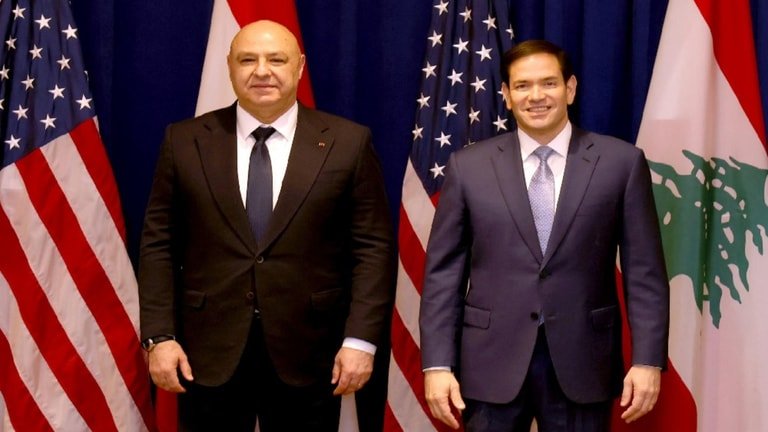
Sources have exclusively revealed to “Jnews Lebanon” that the 60-minute meeting at the US State Department between President Joseph Aoun and Secretary Marco Rubio reflected alignment on the mechanics of addressing the Lebanese situation. The State Department issued a firm statement in which Rubio praised the “courage of the Lebanese government, under President Aoun’s leadership, for its resolute efforts to restore Lebanon’s sovereignty, disarm Hezbollah, dismantle its terrorist infrastructure, and advance toward peace.”
In response to inquiries regarding potential Syrian involvement in Lebanon, US Ambassador to Lebanon Michel Issa confirmed that Secretary Rubio rejected the notion outright, stating that any Syrian engagement in Lebanese affairs remains completely off the table.
For his part, President Aoun emphasized the necessity of aligning the Lebanese and American stances to secure the initial Israeli withdrawal from the first designated pilot zone. He further called for enhanced US military support for the Lebanese Army and bold economic investments in energy, telecommunications, and transport sectors to drive economic recovery.
2. Washington Agenda: Think Tank Roundtable & Strategy Ahead of the Trump Summit
Ahead of Tuesday’s White House meeting, “Jnews Lebanon” has learned that President Aoun is holding an expanded roundtable meeting at the Lebanese Embassy in Washington with directors of prominent political think tanks and strategic policy institutes. This will be followed by high-level meetings with key US Senators and senior administration officials.
These engagements will culminate in a major diplomatic dinner hosted by the Lebanese Embassy, bringing together business leaders, diplomats, and prominent Lebanese, Arab, and American officials to solidify Lebanon’s official stance on state authority and military defense ahead of the summit with President Trump.
3. Regional Flashpoint: US-Iran Confrontation Escalates as Israel Watches Closely
The Lebanese-American summit comes as the regional conflict between Washington and Tehran enters its eighth consecutive night of strikes. US Central Command (CENTCOM) announced ongoing operations targeting Islamic Revolutionary Guard Corps (IRGC) facilities following attacks on US positions in Jordan that resulted in American casualties. Simultaneously, the International Atomic Energy Agency (IAEA) reported it is verifying strikes near the Darkhovin nuclear plant construction site in Iran.
Amid these regional tensions, Israeli officials hinted via Yedioth Ahronoth at the possibility of joining direct military operations against Iran. However, analytical sources confirmed to “Jnews” that the US administration prefers to handle the confrontation independently. Direct Israeli intervention would inevitably draw Hezbollah into reopening the southern front at Iran’s behest—a scenario both Washington and Beirut are eager to avoid to ensure the success of the Lebanese Army deployment plan.
4. Lebanese Media Roundup: From World Cup Highs to Political Realities
Lebanon’s major television networks (MTV, LBCI, Al Jadeed, OTV, NBN) converged in their morning coverage on a single reality: the World Cup festivities have concluded, returning the public focus to regional tensions and diplomatic negotiations. While Donald Trump presented the trophy in New Jersey, he is now turning his attention back to Middle Eastern statecraft from the Oval Office.
Lebanon’s diplomatic path via the “Framework Agreement” faces a critical test. Either the political commitments praised by Secretary Rubio translate into tangible US guarantees—forcing a complete Israeli withdrawal and empowering state institutions—or regional escalation risks undermining these diplomatic efforts.
President Joseph Aoun enters his high-level talks in Washington with a clear mandate: asserting state control over arms under the authority of the army and securing an Israeli withdrawal from occupied southern territory. Following explicit US praise for the government’s efforts toward sovereignty, all eyes remain on Tuesday’s White House summit to see whether these diplomatic assurances translate into concrete field guarantees.