




Written by Aline Barakat for JNews Lebanon
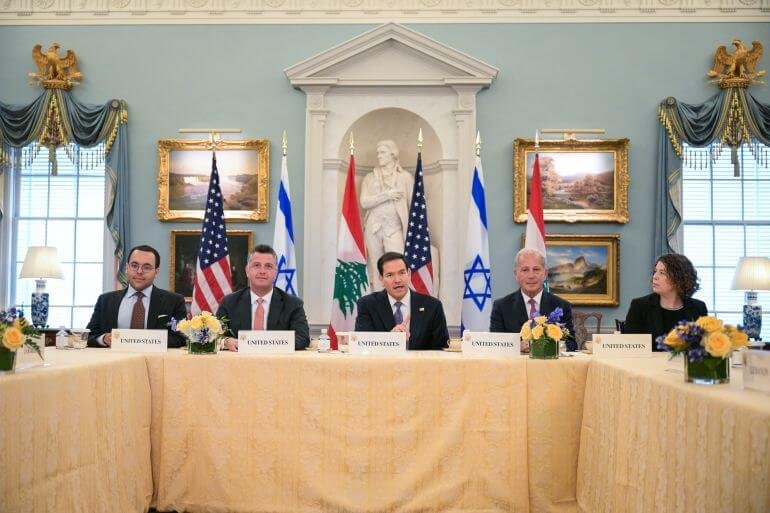
Under the heavy toll of continuous military attrition, the joint statement issued following the fourth round of US-sponsored Lebanese-Israeli talks in Washington has taken on strategic dimensions. It goes far beyond merely drafting a field truce, placing the country at a historic crossroads: either reclaim the concept of a sovereign state or fall completely into the trap of an exploited arena.
The most critical aspect of this agreement lies not just in its military clauses, but in its political and diplomatic parameters. These have opened the door wide to an open, direct confrontation between Lebanese state legitimacy and the regional “Resistance Axis.”
Read also Exclusive- Saudi “Green Light”: A Lifeline Pumps Back into the Lebanese Economy!
1. The Core of the Agreement: Monopolized Arms and Explicit Condemnation of Regional Expansion
For the first time in the history of these negotiations, the “Framework Agreement” includes sovereign points that leave no room for misinterpretation. Its terms intersect directly with the historic decisions of the Lebanese Cabinet, most notably:
- Direct Negotiations: Confirming that any agreement to cease fire and hostilities must be concluded directly between the Lebanese and Israeli governments under US auspices, stripping away any ambiguity over who holds the legitimacy of decision-making.
- Comprehensive Disarmament: The agreement explicitly states that the monopoly of weapons must rest solely in the hands of the Lebanese State (the Army and security forces), viewing any armed activity outside this framework as a flagrant violation of the law.
- Decoupling Regional Links: The statement includes a direct condemnation of what it described as “Iranian aggression” in the region and attacks targeting Arab Gulf states. This represents a bold Lebanese step toward realignment within the Arab and international fold.
- Decisive Field Measures: The framework outlines a comprehensive ceasefire in exchange for strict commitments, most notably a withdrawal north of the Litani River and the adoption of “experimental zones” to exclusively enforce state authority, leading to a non-aggression pact between the two sides.
2. Behind the Scenes of the Shocking Rejection: Tehran Outpaces Beirut in Thwarting the Ceasefire
The wait to gauge the reaction was short. Tehran rushed to declare its categorical rejection of the framework agreement, as it functionally and militarily terminates the role of its regional proxies. The domestic response followed swiftly through local armed political and field channels in an early, calculated attempt to abort this diplomatic track.
Jnews Lebanon Analysis: This immediate rejection reflects the depth of the regional dilemma. While the “Ain el-Tineh” political camp has long promoted the formula, “Give us a comprehensive ceasefire, and we guarantee the armed faction will abide by it,” the sudden reversal by the Shia Duo proves beyond doubt that the decision of war and peace does not reside in Beirut. It demonstrates that the armed party is willing to sacrifice its own community and environment to preserve regional bargaining chips for Tehran in its negotiations with Washington.
Read also Behind the scenes- An Urgent Cable from Damascus: A Firm Message to Hezbollah
3. Treason Accusations and Death Threats: A Paralyzed Judiciary and Helpless Authority
In the background, well-informed political sources reveal to Jnews Lebanon the gravity of the fierce media and political campaign launched by the “intimidation orchestra” opposing the agreement. The campaign did not stop at political treason accusations; it went as far as hurling charges of “high treason” and issuing veiled death threats against the country’s highest constitutional and military authorities, amid a strange and questionable silence from judicial and public safety bodies.
Analytical readings indicate that the lack of “implementation mechanisms” by the Lebanese State, combined with the failure to issue strict political orders to the Lebanese Army to enforce resolutions banning illegal military activities, is precisely what allowed these factions to override the state. It has empowered them to vow woe and destruction upon anyone attempting to rescue the country from the Israeli machinery of devastation.
Read also Behind the scenes- Unannounced Iranian “Veto”….
4. Has “Chapter VII” Become the Only Bitter Remedy?
Faced with the insistence on linking tracks and booby-trapping the “Experimental Zone” proposal—specifically around the Beaufort Castle area designed to protect the city of Nabatieh from military collapse and occupation—diplomatic experts speaking to our site believe that maintaining the status quo bodes poorly. Instead, it grants a green light for expanding Israel’s destructive war.
To avoid a catastrophic existential collapse, the Lebanese government may have only one option left, one that is increasingly being debated in closed political salons: appealing directly to the UN Security Council to request assistance in enforcing state authority under Chapter VII of the UN Charter.
This measure, though a bitter pill to swallow, has become the only mandatory path to impose a ceasefire through international legitimacy—not just in the South, but across all Lebanese territory—preventing the country from being turned to rubble under the banner of “other people’s wars.”